

Around 100 men arrived in Passamaquoddy Bay on June 26, 1604, sailing five French ships into the mouth of the St. Croix River, which separates what is now New Brunswick and Maine. They established the first permanent French settlement in North America on a small island called Muttoneguis (also known as Muttoneguamus, Metanegwis, and Metnegwisby) by the local Indigenous population. Later, the island was renamed Île Ste.-Croix by Pierre Dugua Sieur de Mons, a French explorer and nobleman who led the fledgling colony. It was the birth of Acadia.
In the previous century, Jacques Cartier and other explorers had tried to establish colonies in Sable Island, along the St. Lawrence River, and in Florida, but all were eventually destroyed, and the surviving colonists returned to France. From Île Ste.-Croix, however, the colonists went on to found settlements in Nova Scotia and Quebec, creating a lasting French presence on the continent.
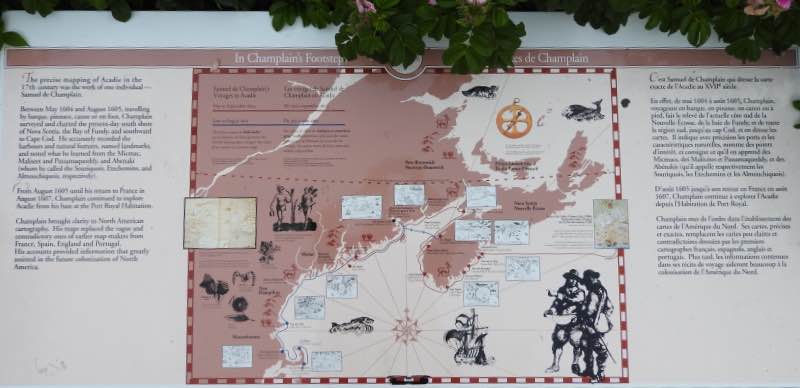
One of the arrivals in 1604 was Samuel de Champlain, a cartographer, while de Mons, who had been granted royal patents to exploit the fur trade in North America and establish the colony of Acadia, led the colony. While Champlain explored the Bay of Fundy and the coastline south to Maine, de Mons and his men cleared land and built dwellings on Île Ste.-Croix.
The Indigenous people had been using Passamaquoddy Bay for its rich saltwater resources, including clams, cod, and seal and porpoise hunting. A small group of Etechemin, ancestors of the Passamaquoddy people, guided the French on their voyage into the bay. According to Champlain’s journals, their Indigenous guides camped that summer on the southern end of Île Ste.-Croix and worked in the settlement’s kitchens. It remains unclear why the French did not learn from the Etechemin not to isolate themselves on the island during the coming winter, which nearly destroyed them.
As the river filled with ice floes, the French were cut off from the mainland, ran out of food and firewood, and were ravaged by scurvy. Almost half the men died, and the survivors were rescued the following March by Indigenous people who brought fresh game, water, and other goods to the island.
In the summer of 1605, de Mons and Champlain dismantled the Ste.-Croix settlement and moved the colony across the Bay of Fundy to Port-Royal, Nova Scotia. In June 2004, hundreds of people gathered in a field in New Brunswick to commemorate the 400th anniversary of the French arrival in the New World. The ceremony included speeches by US Ambassador to Canada, the late Paul Cellucci, then Prime Minister Paul Martin, and New Brunswick Passamaquoddy Chief Hugh Akagi. A parade of boats flying large, ghostly-white sheets meant to look like the sails of the original ships moved slowly up the river, overlooking the small island, now a US-administered historic park, in the middle of the St. Croix River.
This post has already been read 1569 times!


