
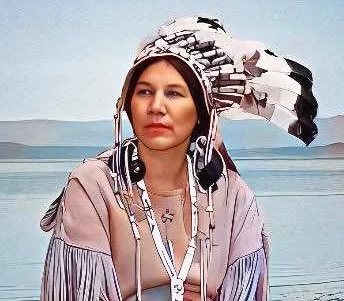
Elder Margaret Pictou LaBillois, one of James and Mary Paul Pictou’s eight children, grew up with her five sisters and two brothers. Following her father’s death, her grandfather became a significant figure in her life, accompanying her on fishing trips and berry picking. LaBillois attended a local Indian day school and made history in 1939 as the first person from her community to graduate from high school with honours.

Post-graduation, she pursued nursing at Hotel Dieu Hospital in Campbellton, located approximately 25 km away by train. Concerned about the financial burden on her widowed mother, who cleaned houses in nearby Dalhousie and walked ten kilometers daily for work, LaBillois struggled with the costs of training, including travel expenses and the frequent replacement of white stockings required for her uniform.
The financial strain of her nursing training led to a pivotal change when she met a Royal Canadian Air Force (RCAF) recruiter on a train journey home. Learning that she could send part of her military pay to support her mother, LaBillois enlisted in the RCAF Women’s Division. She underwent basic training and was stationed at RCAF Station Rockcliffe near Ottawa, where she trained as a photo-reconnaissance technician. Her duties included daring tasks such as leaning out of aircraft to photograph strategic locations like roads and bridges, with the stern warning from a superior that losing a camera could cost her dearly.
LaBillois also contributed to wartime efforts by working on aerial photos used to plan the Alaska Highway, a critical project spurred by fears of a Japanese invasion on the North American west coast. Several men from her community, including her brothers and her future husband, also served in the war. Tragically, her adopted brother Matthew died in England in 1944 while serving with the Canadian army, and another brother also lost his life overseas. After serving for two and a half years, LaBillois returned to her First Nation at the end of World War II.
Margaret LaBillois and Michael LaBillois, an employee at the Dalhousie paper mill, began a relationship that led to marriage. The couple had twelve children—six boys and six girls—and adopted two more boys from their extended family, unwilling to let them be raised by non-relatives.
In 1970, Elder Margaret LaBillois made history as the first woman elected as a First Nation Chief in New Brunswick, holding the position for two terms. During her tenure, she cultivated partnerships across Indigenous and non-Indigenous communities and with governmental bodies. Her leadership, recognized with the Member of the Order of Canada, was noted for creating an atmosphere of mutual understanding and respect, leading to the reclaiming of lands and the revitalization of traditions and language for the people of Eel River.
After her leadership terms, LaBillois dedicated herself to reviving the Mi’kmaw language and culture within her community. Reflecting on her school days when she was restricted to speaking only English, she was motivated to ensure the preservation of her native tongue, helped by her family’s insistence on speaking Mi’kmaw at home.
Understanding the integral role of language in cultural identity, LaBillois pursued and graduated with honours in Indigenous languages from Lakehead University in Thunder Bay in 1982. During this time, her eldest daughter, Colleen, took over household responsibilities to support her mother’s educational endeavours. Back at Eel River Bar First Nation, LaBillois taught Mi’kmaw language, culture, and traditions in local schools and advocated for governmental respect and understanding of Mi’kmaw culture.
Elder Margaret LaBillois also founded a family co-operative business named Apitjipeg, meaning “rebirth.” This venture engaged in diverse activities, including crafting and selling jewelry, mittens, moccasins, and snowshoes, operating a lobster shop and restaurant, and organizing social and cultural events, with her children and grandchildren actively participating in its management.
In 2023, the Native Women’s Association of Canada initiated “Change the Bill,” a campaign designed to highlight the contributions of Indigenous women through art. For this project, nine Indigenous artists were commissioned to envision the $20 bill featuring Indigenous women who inspired them. Mi’kmaw artist Tracey Metallic selected Elder Margaret LaBillois as her subject, depicting her in her RCAF uniform. The redesigned bills were showcased at an exhibition in a Toronto art gallery.

Elder Margaret LaBillois passed away in 2013 at the age of 89 in the Dalhousie Nursing Home. Throughout her life, she received numerous accolades for her leadership and her efforts to preserve Mi’kmaw culture and language. In 1995, she was appointed a Member of the Order of Canada, and a decade later, in 2005, she received the Order of New Brunswick. Additionally, LaBillois was honoured as an Elder by the Union of New Brunswick Indians, recognizing her significant contributions and leadership.
This post has already been read 2289 times!


