Who’s the man with a long beard who visits kids every Christmas, led by a team of reindeer? If you were in Fredericton in the late 1800s, you’d think of Charles A. Sampson. Known for his roles as school trustees’ secretary, Victoria Hospital board member, and leader of Fredericton’s Independent Order of Odd Fellows, Sampson also carved a unique niche as perhaps New Brunswick’s original Santa Claus—a lesser-known facet of provincial history.
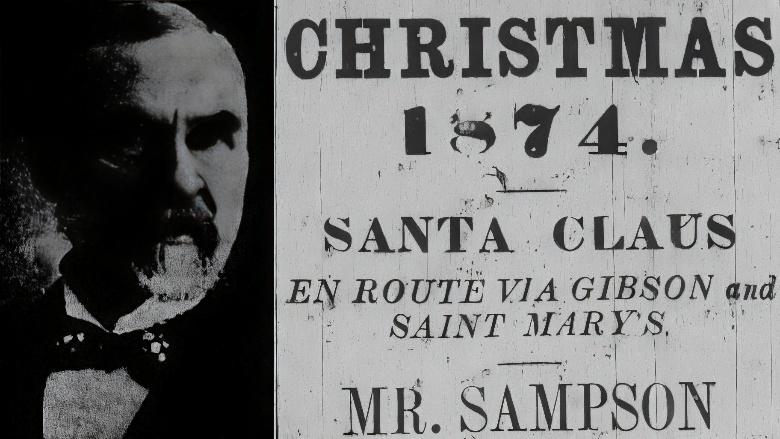
Born in St. Andrews in 1840, Sampson spent most of his life in Fredericton, initially working as a trader with routes from Grand Falls to Boston. In Boston, he encountered a French confectioner, whom he then brought to Fredericton to open a sweet shop right across from the barracks on Queen Street, marking the beginning of his Santa connection.
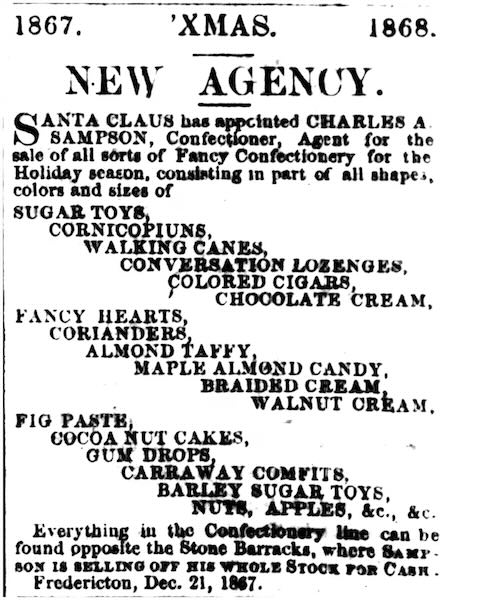
Sampson was a master of marketing, often integrating creative cross-promotions into his business. One notable example was his line of candy, which was sold with train schedules to assist buyers with their travel plans. Recognizing the potential of Christmas and Santa Claus for marketing, at a time when the holiday was far less commercialized, he began promoting his association with Santa in 1867. An ad in the New Brunswick Reporter announced, “Santa Claus has appointed Charles A. Sampson, confectioner, agent for the sale of all sorts of fancy confectionery for the holiday season.” Between 1867 and 1876, Sampson continued to advertise as Santa’s agent, solidifying his commitment to the Christmas icon through regular ads in local newspapers.
Beginning in 1872, Charles Sampson introduced a unique service he called “an entirely new and novel arrangement”: home deliveries by Santa Claus himself. “Any child whose parent had bought candy or toys from his store for stocking stuffers would have their gifts personally delivered by Charles Sampson,” Lavorgna explained. Despite the modern view of Santa as a friendly, old man, Sampson reassured parents about his Santa persona, describing himself in advertisements as “a jovial, pleasant-looking old man, ensuring no child would be scared by his appearance.”

His advertisements boasted, “His rounds through the city will be aided by a splendid team of reindeers or horses pulling a cab, from which he will announce his arrival at each home with a few notes on his well-worn buffalo horn.” Sampson continued to dress as Santa Claus, delivering candies directly to children, even extending his rounds to nearby communities like Marysville and Devon, now part of the city’s north side.
By 1874, his services had expanded beyond just candies to include delivery of any packages from city merchants for a fee of 10 cents per package, ranging from small pills to large barrels of flour. However, not everyone was enthusiastic about his portrayal of Santa Claus. Each year, Sampson faced resistance and was often targeted with snowballs by older boys—a common problem in the city at the time.
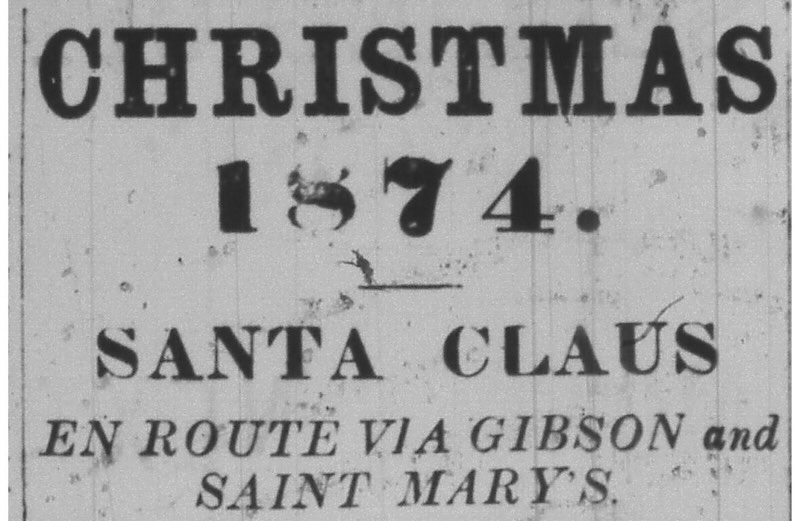
In response to the mischief, Sampson warned in his advertisements that offenders could expect retaliation from his whip, which would leave severe marks, or they might face arrest by the police. Unfortunately, the popularity of Sampson’s Santa service did not last indefinitely. After a few years, he announced that a snowstorm in Santa’s Greenland home would prevent further visits. Lavorgna suggests a simpler reason for the cessation: “It was too much of a good thing. He had simply taken on more than he could manage, overwhelmed by his own success and the sheer number of deliveries in one evening.”
Sampson ran his candy store until 1877 before shifting his career to become the secretary of school trustees in Fredericton, a role he dedicated himself to for the next 40 years. When he passed away in 1929 at the age of 90, local newspapers hailed him as Fredericton’s grand old man, yet by then, his earlier stint as Santa Claus had slipped into obscurity.
Lavorgna noted that the tale of Sampson as Santa always elicits a warm response. “People are touched by it,” she said. “It’s such a charming story. What really surprises people is that it’s true—that it hasn’t been made up or embellished. And it’s particularly intriguing that it’s not widely known.”
Source: CBC
This post has already been read 1032 times!