
New Brunswick holds an intriguing footnote in what the New York Times Book Review once dubbed the most “reprinted, recited, and learned by heart” American poem of all time. You’ll recognize it by its famous opening lines:
“’Twas the night before Christmas, when all through the house. Not a creature was stirring, not even a mouse.”
As the story goes in Fredericton, Mr. Moore sent a handwritten copy of his poem to his godfather’s family the year after he wrote it, making Fredericton one of the first places “A Visit from St. Nicholas“ was ever recited.”
The poem we now know as ’Twas the Night Before Christmas was originally titled A Visit from Saint Nicholas, and despite its cultural imprint, the poem’s authorship and publication history are surprisingly complex.

It is generally credited to Clement Clarke Moore, a Professor of Greek and Latin at New York City’s General Theological Seminary. Moore’s usual writings were far more academic, including a significant work on the linguistic history of Hebrew. While his scholarly pursuits didn’t make him a household name, they caught the eye of a New Brunswicker, a well-known writer himself, though with very different political views from Moore’s.
Jonathan Odell resided in New Jersey before the outbreak of the American Revolution. While Clement Clarke Moore was deeply engaged in American politics, Odell sided with the British during the conflict, writing extensive and vehement anti-American manifestos as a well-known pro-British propagandist.
As the war turned unfavorable for the British, Odell was captured and imprisoned by an American tribunal in New Jersey for his writings. He later escaped with the help of local sympathizers and fled to New Brunswick.
Today, Odell is somewhat of a forgotten figure in New Brunswick—his works are no longer in print—but he remains a notorious character in American cultural memory. He features as a shrewd British spymaster in the 1955 Hollywood movie ‘The Scarlet Coat,’ which portrays him as both intelligent and cynical.
Settling in Fredericton in 1784, Odell became a prominent literary figure in the newly established province. Janice Innis from St. Thomas University commented, “Odell approached his writings about New Brunswick as an observer, which reflected his non-native status.”
Odell’s academic interests led him to admire Moore’s book on Hebrew linguistics, prompting detailed correspondence between the two, though their acquaintance predated the war—Odell had been friends with Moore’s father and was Moore’s godfather.
Amid their scholarly exchanges, a poem Moore wrote for his children, titled “A Visit from St. Nicholas”, surfaced. Historian Ruby Cusack uncovered this poem in the Odell Papers at the Archives and Research Library of the New Brunswick Museum. Cusack’s discovery was deeply personal; she recalled in the Telegraph-Journal how the poem had been a part of her own childhood, shared by her mother and remembered by her grandmother who could still recite it from her childhood in 1890.
Around the time Moore sent a copy of his poem to Odell, it had already been published anonymously in a small New York State newspaper. This publication was not Moore’s doing; instead, it was submitted by a friend without his immediate knowledge or explicit intent for publication.
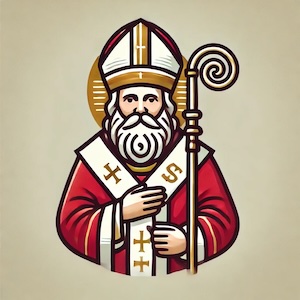
The poem quickly captivated the public’s imagination and was reprinted across various newspapers each Christmas Eve in subsequent years, reshaping the image of Santa Claus in popular culture. Before this poem, Santa was typically depicted in a bishop’s robe, reflecting his origins as St. Nicholas, a 4th-century bishop known for his annual gift-giving ride on December 4th.
Moore’s depiction of St. Nicholas bore a striking resemblance to Jay Duychinck, the elderly gardener at Moore’s estate, who had a white beard, a stubby pipe, a large belly, a jolly demeanor, and rosy cheeks, as noted by New York writer Hugh Mulligan.

Despite its growing popularity, Moore seemed ambivalent about the poem’s fame and only officially published “A Visit from St. Nicholas” in 1844. However, the version discovered in Odell’s papers dates back to 1825 and shows intriguing variations, such as “sugar plumbs” instead of “sugar plums” and slight rearrangements in phrases. A significant alteration in the earlier version includes the names of two reindeer—Donder and Blixen, instead of the later Donner and Blitzen. These names, closely resembling the Dutch words for thunder and lightning (“dunder” and “blixem”), hint at the Dutch heritage of Moore’s gardener.
When Jonathan Odell passed away, his will bequeathed 400 acres of his Rookwood estate to create a public space for the people of Fredericton. This land is now known as Fredericton’s Odell Park, fulfilling his wish for a communal recreational area.
And as the famous poem concludes: “Happy Christmas to all, and to all a good night!”
Click on the video to watch our version of Twas The Night Before Christmas”
This post has already been read 1252 times!